Meridian
Declarative, Kubernetes-first calendar sync. Meridian mirrors events between your own calendars as rule-based, transformed copies, configured entirely as code and running as a single stateless pod. Google Calendar and CalDAV, in any combination.
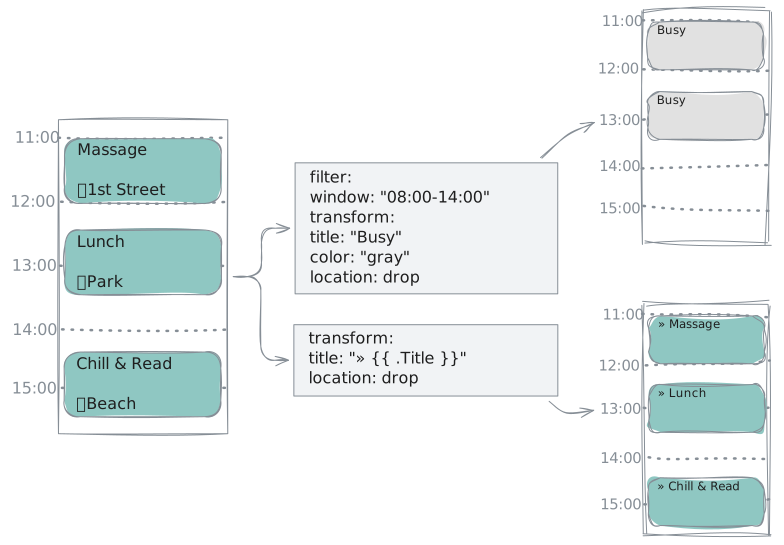
The canonical example: every appointment on your private calendar shows up as an anonymous Busy block on your work calendar. Colleagues see when you’re free. They don’t see why you aren’t.
Important
Status: dogfood. Meridian runs unattended on the maintainer’s homelab, mirroring real calendars around the clock.
It began as one person’s use case, and generalizing past that was the point. Rules, filters and transforms are built to compose, so if your setup differs the difference should land in configuration rather than in a fork.
Is this for you?
Meridian does one thing. It copies events one way, from calendars you name to calendars you name, applying filters and transforms you wrote down in YAML.
Good fit if:
- You already run Kubernetes and want sync rules living in Git alongside everything else you deploy.
- You want one-way mirrors with transformed content, like stripping titles down to “Busy”.
- You’re syncing your own calendars, not running a service for other people.
Not a fit if:
- You want scheduling: finding meeting slots, negotiating free/busy, moving things around. Meridian copies events. It holds no opinions about how you should spend your week.
- You need a genuine two-way merge, where edits on either side flow back to the other.
- You need multi-user or multi-tenant operation from a single install.
- You need Exchange, Outlook, or Microsoft 365. Only Google Calendar and CalDAV are supported.
The full list of constraints lives on Limitations, and it’s worth two minutes before you invest more. The FAQ answers why it’s built this way.
How it works
Meridian reconciles the way a Kubernetes controller does. Each cycle it fetches every event in a rolling window from your source and destination calendars, works out which copies should exist, and makes the destination match: create, update, or delete.
Those copies are called shadows, and every one carries an ownership marker naming the instance and rule that created it. Meridian only ever touches shadows it made itself. Your own events, and other tools’ events, are invisible to it.
There’s no database and no sync cursor. The calendars hold the state. That means a crashed pod, a restored backup, or a config change all converge the same way: by looking at what’s there and fixing the difference.
    flowchart LR
    A[Fetch source events] --> B[Compute desired shadows from rules]
    B --> C[List destination shadows]
    C --> D{Diff by content hash}
    D -->|new| E[Create]
    D -->|changed| F[Update]
    D -->|orphaned| G[Delete]
    E & F & G --> H[Next cycle]
    H --> A